
The US Patent Office was founded in 1790 and since that time over 9,000,000 patents have been granted. Some of these patents are more notable than others either because of their effect on society or by notability of the inventor. In the Patent Offices long history a fire in 1836 caused the destruction of a great many patents, some of which have been recovered and many of which are lost. Originally patents were not numbered but were recorded by date. Those patents issued prior to the 1836 fire are referred to as “X-Patents”. The first numbered patent was granted in 1837. From 1790 until 1836 roughly 10,000 patents were granted several of which deserve mention here.
The first US Patent (X1) “Potash and Pearls” was granted to Samuel Hopkins in 1790 signed by George Washington. The process described teaches a means of producing an acidic solution for industrial purposes.
US Patent (X72) "Cotton Gin” was granted to Eli Whitney is an early example of farm mechanization. The invention separated seed from cotton efficiently which was previously a labor intensive task usually carried out by slaves on southern plantations. Some people think the invention reduced the need for slavery and in some way contributed to the elimination of slavery years later.
US Patent (X177) “Cast Iron Plow” was granted to Charles Newbold in 1797. While the invention represented an advance in the state of the art that could improve farm efficiency it was not at first well received due to fears of the iron poisoning the soil.
US Patent (x9430) “Revolving Gun” was granted to Samuel Colt in 1836 for the first Colt revolver
US Patent 132 “Improvement in Propelling Machinery by Magnetism and Electro-Magnetism” was granted to Thomas Davenport in 1837 providing the first commercial electric motor built using principles taught by others previously. The primary problem with the machine was its dependence on electric batteries for operation. The invention preceded development of electrical distribution systems and the lack of good batteries led to the commercial failure of this motor. It would be many years before commercial electric motors would come into common use.
US Patent 169 “Loom” granted to E.B. Bigelow 1837
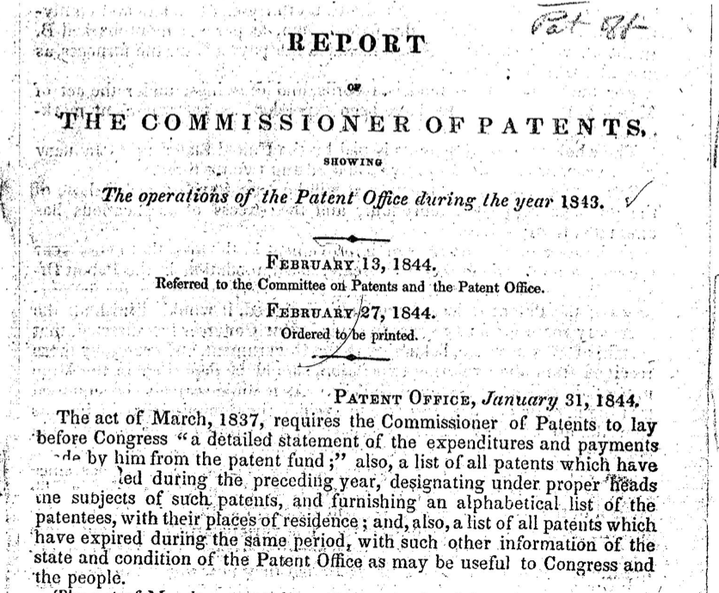
US Patent 1647 “Telegraph Signs” granted to Samuel F.B. Morse patented in 1840. The invention of the telegraph marks a milestone in American history ushering in the information age. The invention allows the communication of messages over great distances at the spped of lightning. It is worthy to mention that Samuel Morse was awarded his patent in 1840 and that it was not put into practice immediately. Morse was friends with then Commisioner of Patents Henry Ellsworth. At that time it was the responcibility of the Commisioner of Patents to produce an annual report to congress summeriing the events of the year and to explain the benefits of the patent system to the well being of the American people. In the 1843 annual report Commisioner Ellsworth covers many items including the telegraph.
US Patent 3,633 (Goodyear) entitled, “Improvement in India Rubber Fabrics"
US 6,469 (Lincoln) entitled, “Buoying Vessels Over Shoals”